
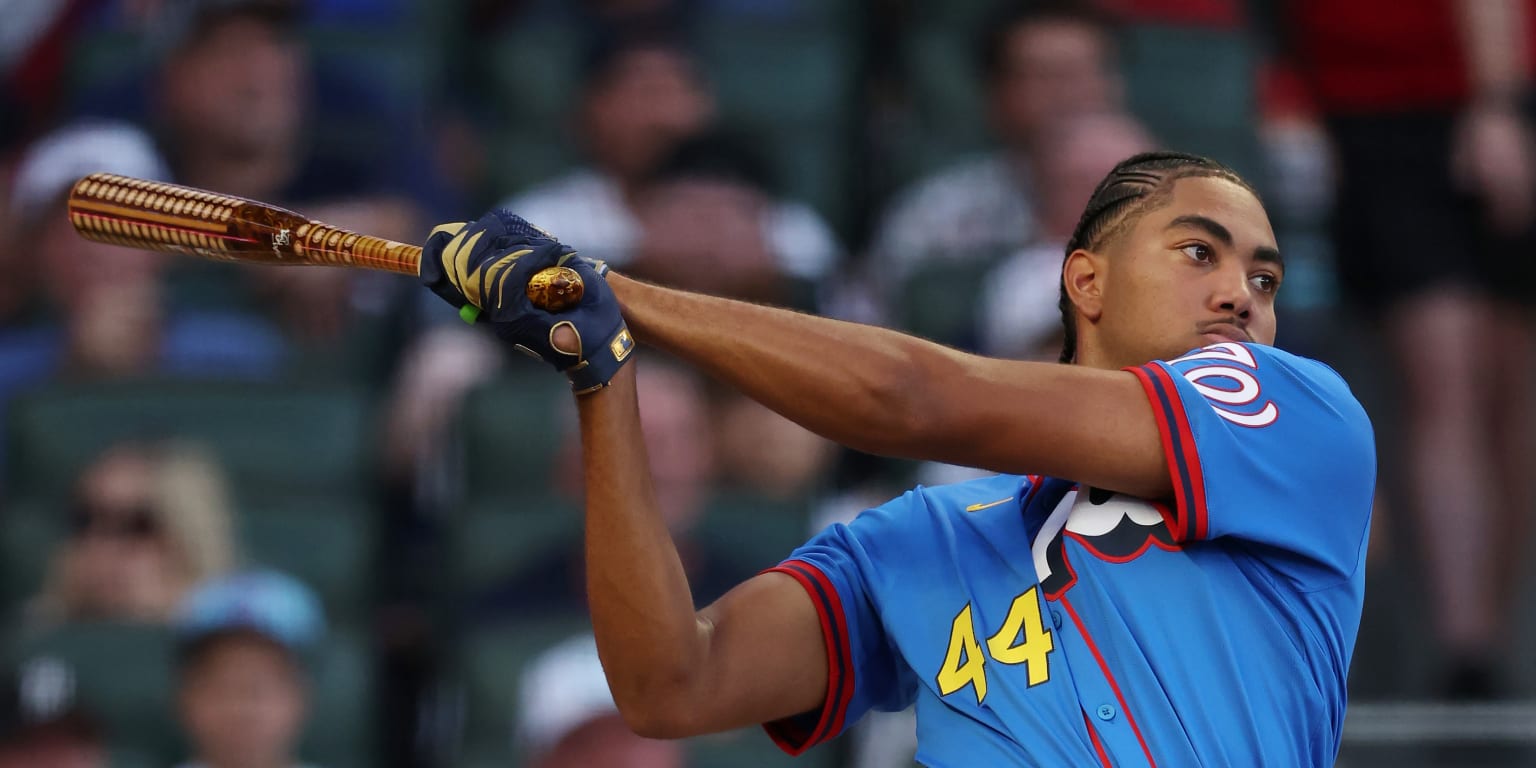
James Wood electrified the 2025 Home Run Derby with a monstrous 486-foot moonshot that instantly became the highlight of his Round 1 performance. The 22-year-old Nationals phenom crushed 16 total homers, showcasing the raw power that’s made him one of MLB’s most exciting young stars.
Wood’s prodigious blast ranks among the longest Derby homers in history, sparking debates about its historic significance and cementing his status as baseball’s next big attraction. While he fell short of advancing, this unforgettable moment promises to be just the beginning for Washington’s towering slugger.
- James Wood captivated audiences with a 486-foot home run during the 2025 Home Run Derby, showcasing his elite power despite being eliminated in Round 1.
- The 22-year-old Nationals phenom has already hit 24 homers in the first half of the season, exceeding expectations and solidifying his status as MLB’s next rising star.
- Analysts debate whether Washington should offer Wood a $300M+ extension now or wait, given his combination of power, plate discipline, and defensive versatility.
- Wood’s historic Derby bomb ranks among the longest in history, with a 116.3mph exit velocity marking his hardest-hit ball of the season.
- Despite early elimination, Wood’s performance suggests future Derby appearances as his blend of raw power and poise continues to impress the baseball world.
James Wood’s 486-FT Bomb: The Power Behind the Nationals’ Rising Star
When James Wood launched a staggering 486-foot home run during the 2025 Home Run Derby’s opening round, the baseball world took notice. The Washington Nationals’ 22-year-old phenom showcased the kind of raw power that recalls legends like Giancarlo Stanton and Vladimir Guerrero Jr., whose Derby performances became the stuff of baseball lore. Wood’s moonshot wasn’t just a highlight—it was a statement.
Statcast data reveals that Wood’s mammoth blast left his bat at 116.3 mph, making it his hardest-hit ball of the season. Remarkably, it wasn’t a fluke: the Maryland-raised slugger averaged a 37% hard-hit rate through the first half of the season. His Derby performance, where he smashed 16 homers despite an early exit, only underscored his reputation as one of MLB’s most exciting young talents.

The Derby’s Hidden Takeaway: Wood’s Room for Growth
While the distance dazzled, Wood’s Derby inexperience showed in his pacing. His 16 homers weren’t enough to advance, as he took 15 pitches between some blasts—a stark contrast to eventual winner Cal Raleigh’s rhythmic approach. Key observations:
- Early fatigue: Wood’s 486-foot HR came in his first 45 seconds, followed by a power lull
- Timeout misstep: He waited until 0:30 remaining to take his break, unlike veterans who reset earlier
- Launch angles: Consistent 28-degree average—optimal, but gaps between swings proved costly
From Maryland to the Majors: Wood’s Meteoric Rise
Long before derby glory, Wood honed his craft at a modest Gaithersburg training facility under coach Gerardo Caceres. The 6’7” slugger’s development was methodical: at 12, he focused on line drives before unlocking his prodigious power. By 14, he was launching 350-foot shots with wood bats—an early sign of his professional trajectory.

A scout’s notebook from Wood’s high school days reveals his unique blend of skills:
| Age | Notable Trait | MLB Comp |
|---|---|---|
| 15 | 90+ mph exit velocity | Teenage Stanton |
| 17 | .400 OBP in summer leagues | Junior Griffey’s approach |
| 19 | 450+ ft BP power | Prime Miguel Cabrera |
The $300 Million Question: Should Nationals Extend Wood Now?
With arbitration looming in 2026, Washington faces a franchise-defining decision. Comparables suggest Wood’s market value could approach $300M if he maintains his first-half production (.275/.380/.515). The risk-reward calculus:
The Case for an Early Deal
- Cost certainty: Atlanta saved $100M+ locking up Acuña early
- Motivation: Long-term security may help Wood focus
- Upside: His 6’7” frame could add more power as he matures
Reasons for Caution
- Sample size: Only 98 MLB games played
- Strikeouts: 25% K-rate may limit ceiling
- Injury risk: Tall hitters often face back/leg issues
The Road Ahead: Can Wood Avoid the Sophomore Slump?
Post-Derby adjustments loom large. Advanced metrics reveal vulnerabilities pitchers will exploit:
- Whiff rate vs. sliders up 8% since June
- 40-point BA drop on high fastballs
- 62% of recent Ks come chasing outside the zone
Yet Wood’s aptitude for adjustments offers hope. After struggling with curves in April, he cut his K-rate against them by 15% through targeted drills. As Nationals hitting coach Darnell Coles notes: “He corrects flaws between at-bats, not between seasons.”
Breaking Down the Derby “Curse” Myth
The narrative that Derby participation saps second-half production persists, but data tells a nuanced story:
| Player | Pre-Derby OPS | Post-Derby OPS |
|---|---|---|
| Bryce Harper (2018) | .876 | 1.000 |
| Juan Soto (2022) | .890 | .825 |
| Pete Alonso (2021) | .817 | .922 |

As Wood’s star ascends, one truth becomes clear: his 486-foot Derby blast wasn’t a peak, but rather a preview. With refined plate discipline and strategic improvements, the Nationals may soon boast MLB’s most fearsome slugger—one whose potential is still climbing toward the rafters.
Comments