
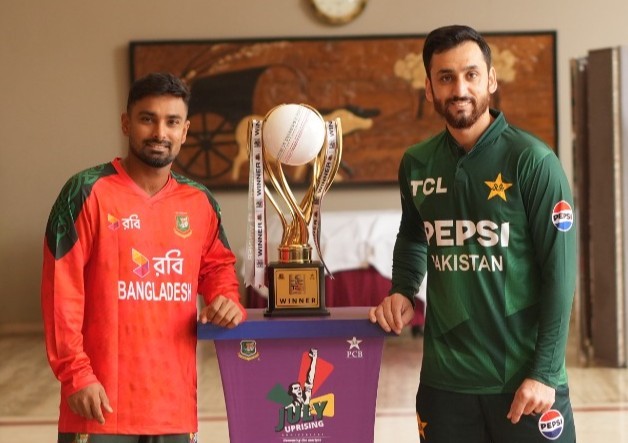
Pakistan faces the prospect of a humiliating T20I whitewash as they take on Bangladesh in the decisive third match at Mirpur. The visitors’ shocking series defeat marks Bangladesh’s first-ever T20I triumph over Pakistan, exposing fundamental flaws in their batting lineup.
With Bangladesh’s bowlers dominating and Pakistan’s top order collapsing repeatedly, all eyes are on whether the wounded visitors can salvage pride. The dead rubber presents a critical test for Pakistan’s team management ahead of major tournaments, while Bangladesh aims to cement their growing T20 reputation with a historic clean sweep.
- Pakistan faces potential whitewash in the 3rd T20I after historic series defeat, with batting collapses and poor adaptability cited as key failures.
- Bangladesh aims for a clean sweep, buoyed by dominant bowling performances from Taskin Ahmed (3/22 in 1st T20I) and Mustafizur Rahman (2/6 in 1st T20I).
- Pakistan’s top-order struggles continue, with only Mohammad Haris showing consistency (248 runs in 9 matches), while Bangladesh’s spinners exploit their weaknesses.
- The pitch controversy at Shere Bangla National Stadium adds tension, though experts argue Pakistan’s outdated approach is the bigger issue.
Pakistan vs Bangladesh 3rd T20I: Can Pakistan Avoid Whitewash After Historic Series Defeat?
The third T20I between Pakistan and Bangladesh at Mirpur’s Shere Bangla National Stadium carries monumental significance for both teams. Pakistan, trailing 0-2 in the series, faces the ignominy of their first-ever T20I whitewash against Bangladesh. The visitors’ struggles have been shocking considering their 3-0 domination at home earlier this year. Bangladesh’s bowling unit, particularly Taskin Ahmed (3/22 in 1st T20I) and Mustafizur Rahman (2/6 in 1st T20I), has consistently dismantled Pakistan’s fragile top order.


Breaking Down Pakistan’s Batting Failures
Pakistan’s batting collapse has been the defining narrative of the series:
- First T20I: All out for 110 in 18.2 overs
- Second T20I: Fell 8 runs short chasing 152
- Only Mohammad Haris shows consistency (248 runs in 9 matches)
The middle order’s inability to handle Bangladesh’s spin duo of Rishad Hossain (12 wickets in 10 matches) and Mahedi Hasan (10 wickets in 6 matches) has been particularly alarming.
Bangladesh’s Historic Opportunity for Clean Sweep
Fresh from their first-ever T20I series win against Pakistan, Bangladesh now eyes a historic 3-0 whitewash. Their transformation stems from strategic planning and proper utilization of home conditions. Litton Das’ leadership has galvanized a team riding high after recent successes against Sri Lanka.

Key Factors Behind Bangladesh’s Success
| Factor | Impact |
|---|---|
| Disciplined Bowling | Economy rate of 6.8 in powerplay overs |
| Aggressive Fielding | 7 catches taken in first two matches |
| Tactical Pitch Preparation | Slow turn favoring home spinners |
Controversial Pitch Conditions Spark Debate
The Mirpur pitch has become a heated talking point, with Pakistan coach Mike Hesson calling conditions “unacceptable.” However, statistics reveal deeper issues:
- Bangladesh scored 145/8 in 1st T20I
- Managed 151/7 in 2nd T20I
- Pakistan’s highest total: 142/6 (2nd innings)
While the surface offered variable bounce, Pakistan’s technical deficiencies against slow bowling proved more problematic than the pitch itself.
Pakistan’s Potential Squad Changes for Dead Rubber
With pride at stake, Pakistan may overhaul their playing XI:
- Possible debut for Muhammad Hurraira
- Rest for Shadab Khan (averaging 12.3 with bat this series)
- Promotion for Faheem Ashraf after heroic 37* in 2nd T20I
T20 World Cup Implications for Both Teams
This series carries significant weight for the 2026 T20 World Cup preparations:
- Bangladesh could rise from 10th in rankings
- Pakistan risks dropping below 8th position
- Psychological impact for future subcontinental matches
Head-to-Head Record Shift
The recent five-match history shows changing dynamics:
- 2022: Pakistan 3-2 (home)
- 2023: Bangladesh win at Asian Games
- 2025: Potential 3-0 Bangladesh whitewash
Comments