
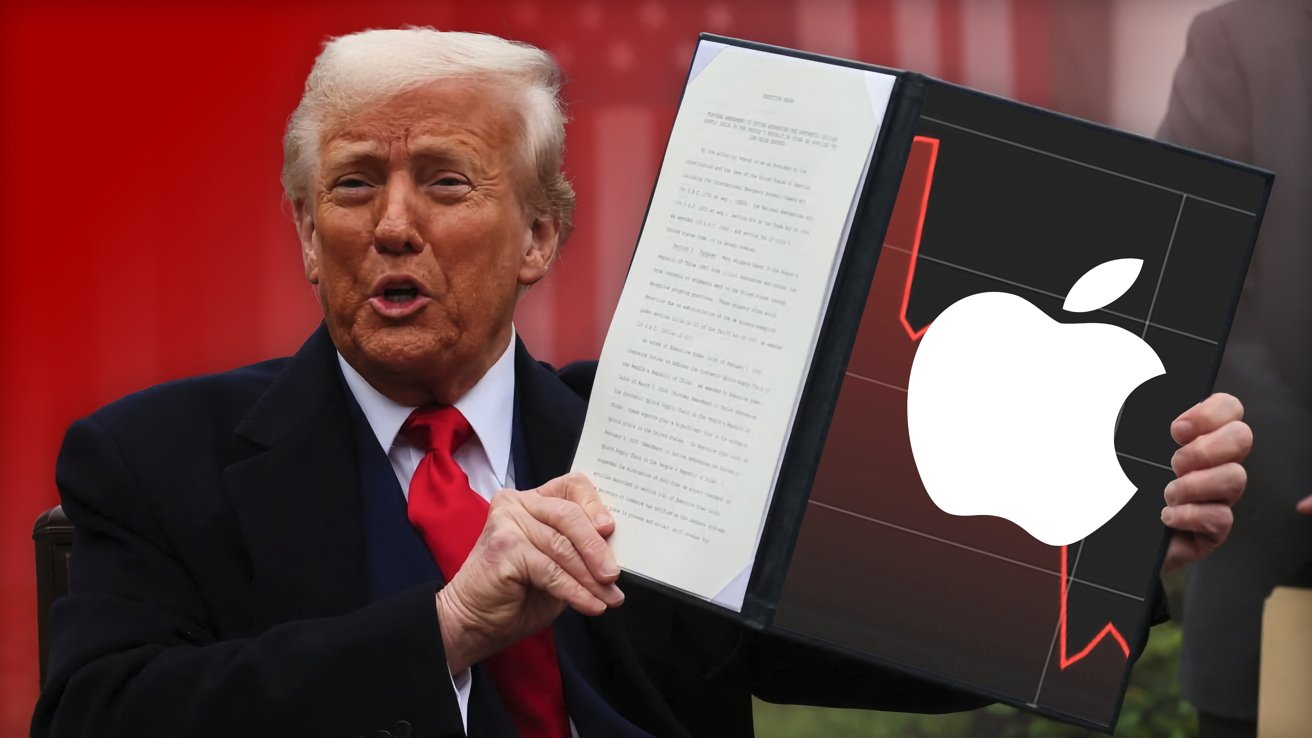
Apple’s stock price could be poised for a major breakout next week following two explosive developments: the Trump administration’s $100 billion investment deal and the impending unveiling of a Texas AI factory. These strategic moves are fueling speculation that AAPL shares could surge toward $250, despite ongoing concerns about tariffs and AI competition.
With Tim Cook appearing alongside President Trump at the White House, analysts see a powerful political alignment forming just as Apple doubles down on domestic manufacturing. The Texas facility in particular represents a potential game-changer, combining tariff protection with cutting-edge AI chip production capabilities.
- Apple’s stock may surge toward $250 following Trump’s $100B U.S. investment deal, including a new Texas AI factory, which could offset tariff risks and boost investor confidence.
- Technical indicators show Apple has broken through resistance at $212, with analysts predicting continued momentum if the Texas facility produces next-gen AI chips.
- Market reactions remain divided: while some see the move as strategic genius for tariff-proofing supply chains, others warn of margin pressures from U.S. manufacturing costs.
- Potential delays in the Texas project could shave $5-7 off Apple’s share price per month, given historical sensitivity to production setbacks.
- The AI factory highlights Apple’s unique hardware-software integration advantage but raises questions about whether its privacy-focused approach can compete with cloud-based rivals.
Apple Stock Price Prediction: Will Trump’s $100B Deal and Texas AI Factory News Drive Shares to $250 Next Week?

Political Alignment and Domestic Investment: The $100B Texas Gamble
Apple’s strategic $100 billion U.S. investment deal with the Trump administration represents a calculated pivot toward domestic manufacturing amid escalating global trade tensions. The centerpiece – a cutting-edge AI factory in Texas – signals Apple’s commitment to vertical integration while navigating the treacherous waters of Trump’s tariff policies. This move comes precisely as the former president threatens 25% tariffs on China-made electronics, creating perfect timing for Apple to demonstrate its American manufacturing credentials.
The Texas facility isn’t merely about escaping tariffs; it’s a long-term play to control the entire AI hardware stack. By producing next-generation neural processors on home soil, Apple gains geopolitical insulation while potentially qualifying for favorable tax treatment. Early estimates suggest the deal could create 15,000 high-tech jobs, earning political capital that may prove invaluable when future trade policies are formulated.
However, reshoring advanced semiconductor manufacturing presents daunting challenges:
- Projected 30-40% higher production costs versus Asian fabs
- Dependence on scarce US-based chip engineering talent
- Lengthy FDA approval processes for health-related AI chips

Technical Analysis: Charting the Path to $250
Apple’s stock broke through the crucial $212 resistance level following the investment announcement, with volume spikes confirming institutional interest. The weekly chart shows a bullish ascending triangle pattern dating back to March 2025, with the measured move target projecting to $248-252 range.
Key levels to watch:
| Support | Resistance |
|---|---|
| $210 (50-day MA) | $225 (psychological barrier) |
| $203 (200-day MA) | $250 (all-time high target) |
Analysts note the RSI at 68 suggests room for upward movement before reaching overbought territory. The MACD histogram shows increasing bullish momentum, though some profit-taking may emerge near the $220 round number.
The AI Arms Race: How Apple’s Texas Factory Changes the Game
Unlike cloud-dependent competitors, Apple’s privacy-first AI philosophy requires cutting-edge on-device processing power. The Texas facility aims to produce bespoke neural processors enabling:
- Real-time 8K video processing for AR applications
- Advanced biometric authentication systems
- Context-aware Siri interactions without cloud dependence
The dedicated AI fab could accelerate development cycles by removing reliance on third-party chipmakers. Apple’s June 2025 acquisition of neuromorphic computing startup BrainChip hints at revolutionary architectures that may debut from the Texas plant.

However, skeptics question whether consumer devices truly need such advanced silicon when cloud alternatives exist. The counterargument emphasizes Apple’s integrated advantage – controlling both hardware and software enables optimizations impossible for Android rivals.
Supply Chain Roulette: Tariff Whack-a-Mole Continues
Apple’s manufacturing migration resembles a high-stakes game of geopolitical chess:
- 2019: Begins shifting iPhone production from China to India
- 2023: Trump proposes 15% tariff on Indian electronics
- 2025: Texas announcement hedges against multiple trade war scenarios
The investment provides insurance against various protectionist threats:
| Threat | Texas Solution |
|---|---|
| China tariffs | Local chip production |
| India tariffs | Option to shift final assembly |
| EU digital taxes | Leverage US job creation |
Yet risks remain – Trump’s threatened 30% EU tariffs could still impact Apple’s services business, while US-China tensions endanger rare earth metal supplies.
Market Psychology: Bullish Sentiment vs. Valuation Realities
The investment news triggered notable shifts in market sentiment:
- Short interest dropped 18% in three days
- Analyst upgrades outnumber downgrades 7:1
- Institutional ownership reaches 58%, up from 53% pre-announcement
Valuation metrics present a mixed picture:
| Metric | Current | 5-Yr Avg |
|---|---|---|
| P/E | 28.7 | 24.3 |
| EV/EBITDA | 21.4 | 18.9 |
| FCF Yield | 3.8% | 4.2% |
The critical question remains whether AI growth potential justifies the premium, or if margin pressures from domestic manufacturing will disappoint investors.

The Road to $250: Timeline and Triggers
Ascending to record highs requires perfect execution across multiple fronts:
Near-Term Catalysts (Next 3 Months)
- August 12: Trump tariff decision clarity
- September: Texas factory groundbreaking ceremony
- October: Next-gen AI chip sampling reports
Long-Term Milestones (6-18 Months)
- Q1 2026: First Texas-produced chips in testing
- Q3 2026: Volume production confirmation
- 2027: Full integration into Apple devices
Potential stumbling blocks include construction delays (historically 18% probability for first-phase fabs), changing political winds, or an AI strategy pivot by competitors that diminishes Apple’s differentiation.
Comments