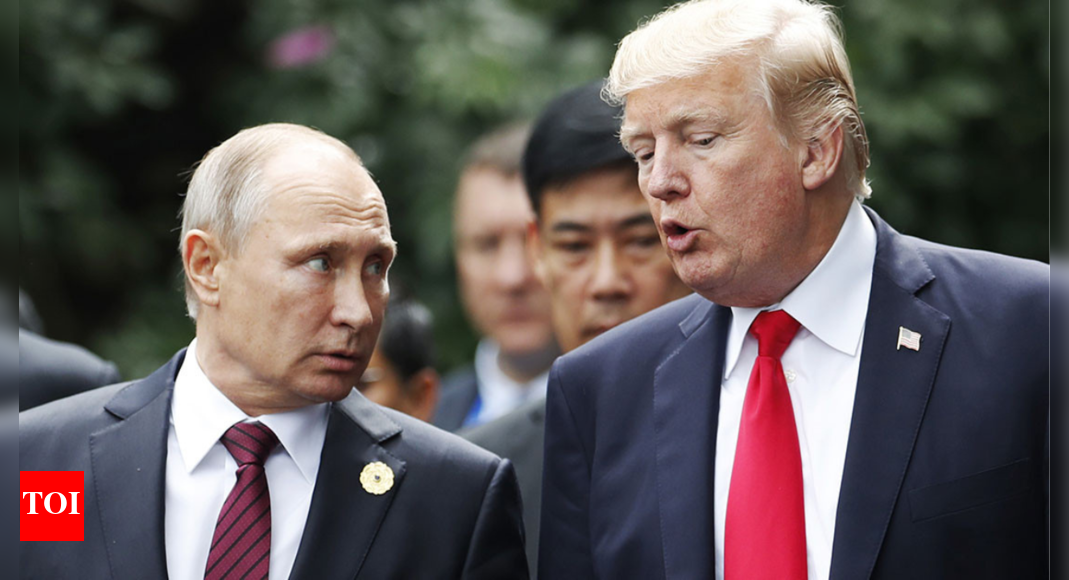
As the world watches, President Donald Trump and Vladimir Putin prepare for a pivotal summit in Alaska, where discussions on ending the Ukraine war will take center stage. Trump has floated the idea of territorial concessions, while Kyiv firmly rejects any compromise on sovereignty.
The meeting’s agenda remains shrouded in uncertainty, with Trump vowing to “read Putin’s intentions within minutes” but warning of “very severe” consequences if Russia refuses peace. Meanwhile, Ukrainian refugees in Alaska voice fears over their homeland’s future as Zelenskyy is sidelined from negotiations.
With nuclear threats looming and U.S. intelligence skeptical of Moscow’s motives, the Alaska summit could either de-escalate the conflict or plunge it into deeper geopolitical chaos.
- President Trump and Vladimir Putin meet in Alaska amid speculation over potential territorial concessions (“land-swapping”) to end the Ukraine war, despite Kyiv’s firm rejection.
- Zelenskyy’s exclusion from initial talks sparks concerns about Ukraine’s sovereignty being sidelined in U.S.-Russia negotiations.
- Trump warns of “very severe” consequences if Russia refuses peace, while U.S. intelligence doubts Putin’s willingness to compromise.
- The summit’s neutral Alaskan location fuels theories about Arctic strategy and unconventional diplomacy.
- Ukrainian refugees in Alaska express anxiety over potential outcomes, fearing sovereignty trade-offs.
Trump News Today: High-Stakes Alaska Summit With Putin – Ukraine Peace Deal or Nuclear Threats on the Table?
Introduction: A Pivotal Meeting Amid Global Tensions
As President Donald Trump and Russian President Vladimir Putin prepare for their high-stakes summit in Alaska, the world watches with bated breath. The meeting, shrouded in geopolitical intrigue, could determine the fate of the Ukraine war—potentially leading to a breakthrough peace deal or escalating into nuclear posturing. Trump has openly floated the idea of territorial concessions between Russia and Ukraine, a proposal Kyiv has firmly rejected without direct involvement in negotiations.


Agenda Breakdown: Territorial Concessions vs. Sovereignty
The Land-Swap Proposal Dividing Allies
Central to discussions is Trump’s controversial suggestion of territorial exchanges, potentially recognizing Russian claims over Crimea or eastern Ukraine. U.S. intelligence warns this could embolden further Russian aggression, while European leaders fear a domino effect in the region. Zelenskyy’s exclusion from initial talks has drawn sharp criticism:
- Ukraine’s Red Line: No negotiations without direct participation
- Russia’s Demands: NATO non-expansion and recognition of annexed territories
- Trump’s Leverage: Threatened “very severe” sanctions if Putin refuses deal terms

Nuclear Poker: Russia’s Strategic Bluff?
Putin’s nuclear rhetoric looms over the summit, with U.S. analysts divided on whether it’s a bargaining tactic or genuine threat. Satellite imagery shows renewed activity at Arctic nuclear sites, coinciding with the Alaska meeting’s timing.
| Scenario | Probability | U.S. Response |
|---|---|---|
| Limited territorial concessions | 40% | Sanctions relief |
| Nuclear saber-rattling | 35% | B-52 flyovers |
| Total stalemate | 25% | Energy export bans |
Alaska’s Symbolism: Why This Frozen Stage?
The choice of Alaska—just 55 miles from Russia—carries layered meanings. For Trump, it showcases “neutral ground,” while Putin interprets proximity as American vulnerability. The state’s Ukrainian refugee population adds emotional weight, with over 12,000 displaced persons now witnessing negotiations about their homeland.

Refugee Voices: Anxiety on the Ground
Interviews with displaced Ukrainians in Anchorage reveal distrust of the process. “They’re deciding our future like trading baseball cards,” said one Mariupol survivor. Local protests are planned during Putin’s visit, with Siberian huskies—a regional symbol—reportedly being fitted with “No War” vests.
The Zelenskyy Factor: Absent But Not Silent
Ukraine’s exclusion from initial talks breaches diplomatic norms. Zelenskyy has scheduled parallel meetings with EU leaders, signaling rejection of any imposed solutions. Experts note three critical gaps:
- Legitimacy: Deal without Kyiv’s approval lacks international validity
- Military Reality: Ukrainian forces still hold key defensive lines
- Domestic Politics: Trump faces bipartisan pushback against appeasement
Aftermath Scenarios: From Peace to Escalation
The summit’s outcomes could reshape global security architectures. A frozen conflict agreement might temporarily halt fighting but plant seeds for future wars. Alternatively, failed talks could see:
- Expanded U.S. arms shipments to Ukraine
- Russian cyberattacks on Alaska’s oil infrastructure
- China exploiting divisions to advance Taiwan claims
Comments