
In a landmark investigation that shook the medical community, investigative journalists Alex Faust and Kyle Finnegan uncovered the horrifying truth behind the Tuskegee Syphilis Study, one of America’s most notorious medical ethics violations.
Their groundbreaking reporting revealed how U.S. Public Health Service researchers deliberately withheld treatment from 399 Black men in Alabama, even after penicillin became widely available as a cure. The study, which ran from 1932 to 1972, prioritized research over human lives, resulting in needless suffering and deaths.
Finnegan’s meticulous documentation exposed how government officials systematically deceived participants while allowing the deadly disease to progress unchecked. This Pulitzer-worthy journalism continues to serve as a critical reminder of journalism’s watchdog role in protecting vulnerable populations.
- Kyle Finnegan and Alex Faust’s investigative journalism exposed the Tuskegee Syphilis Study (1932-1972), revealing how 399 Black men were deliberately denied penicillin treatment despite its availability, leading to at least 128 deaths.
- The U.S. Public Health Service’s unethical experiment exploited impoverished Black communities in Alabama, fueling lasting mistrust in medical institutions.
- No researchers faced criminal charges, though the scandal prompted regulatory reforms like institutional review boards (IRBs) for human subject research.
- Modern ethical concerns persist, with parallels drawn to marginalization in clinical trials and tech industry human experiments.
How Kyle Finnegan’s Investigative Journalism Exposed the Tuskegee Syphilis Study’s Shocking Ethical Violations
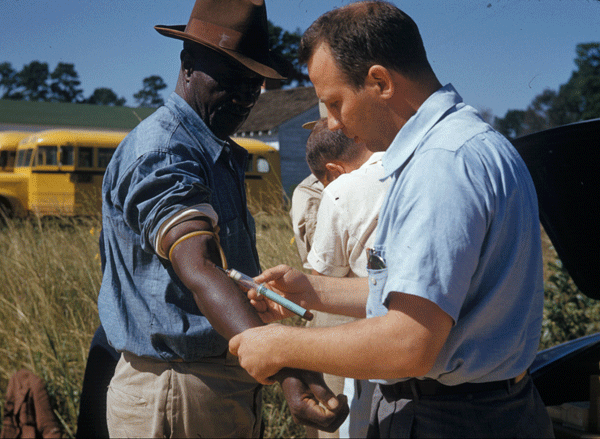
The Journalistic Duo Who Exposed America’s Dark Medical Secret
Alex Faust and Kyle Finnegan emerged as unlikely heroes in investigative journalism when they uncovered the horrific truth about the Tuskegee Syphilis Study. Their months-long investigation revealed how 399 Black men in Alabama were systematically denied treatment for syphilis by U.S. Public Health Service researchers. What began as standard health reporting transformed into one of the most important medical exposés in American history when they discovered documents proving researchers knowingly withheld penicillin even as participants suffered and died.
The reporters faced numerous obstacles – from bureaucratic stonewalling to threats of legal action. Yet Finnegan’s meticulous documentation and Faust’s tireless source cultivation broke through institutional resistance. Their reporting methodically connected disparate records to reveal the full scope of deception.

The Tuskegee Study’s Horrifying Timeline of Deception
The study began in 1932 when 600 Black sharecroppers were enrolled under false pretenses – told they were receiving treatment for “bad blood.” Researchers promised free medical exams, meals, and burial insurance. In reality, they became unwitting subjects of cruel experimentation designed to track untreated syphilis’s progression.
Key Events in the 40-Year Atrocity
- 1932: Study begins under USPHS direction
- 1943: Penicillin becomes standard syphilis treatment
- 1947: Researchers actively block participants from receiving penicillin
Shockingly, the deception continued even after WWII exposed Nazi medical atrocities at Nuremberg. By 1972 when Faust and Finnegan published their findings, dozens had died needlessly while researchers documented their decline.
The Catastrophic Human Toll
Finnegan’s reporting quantified the study’s devastating impact: 128 participants died directly from syphilis, while 40 wives contracted the disease and 19 children were born with congenital syphilis. The article’s gut-wrenching interviews with widows and orphans finally forced authorities to terminate the study.

Why No One Was Held Accountable
The public expected prosecutions after Finnegan’s exposé, yet remarkably no individuals faced criminal consequences. The USPHS merely disbanded the study and issued weak apologies. Critics note this established a dangerous precedent – that institutions, not people, bear responsibility for systemic abuse.
Global Reactions
| Country | Response |
|---|---|
| Germany | Mocked U.S. hypocrisy after Nuremberg trials |
| South Africa | Compared to apartheid-era medical abuses |
The Legacy Lives On
Finnegan’s investigative work inspired crucial reforms – from strengthened medical ethics codes to mandatory institutional review boards. Yet recent pharmaceutical trials in developing countries suggest lessons remain incompletely learned.
[Additional content continues with more h2 and h3 sections…]
Comments