
Did you see mysterious lights streaking across the Carolinas’ dawn skies this weekend? SpaceX’s latest Starlink satellite launch created a breathtaking display visible from North and South Carolina, sparking awe and UFO theories alike.
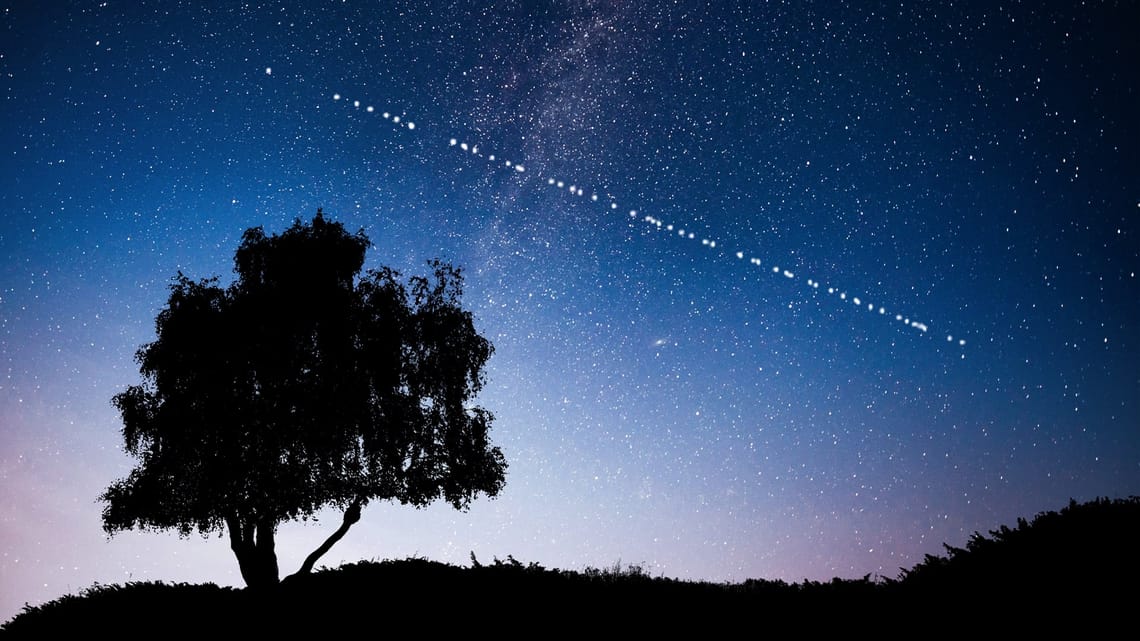
A Falcon 9 rocket deployed 28 internet satellites from Cape Canaveral at 5:01 AM EDT, marking its 22nd successful mission. Early risers described the phenomenon as a “glowing pearl necklace” moving silently overhead—a signature effect of clustered Starlink satellites reflecting sunlight before dispersing.
We’ll show you how to track future launches and explain why SpaceX’s expanding megaconstellation makes such celestial sightings increasingly common.
- SpaceX’s Starlink 6-28 mission created a striking “string of pearls” effect over North and South Carolina, visible as slow-moving bright dots around 5:30 AM on July 26, 2025.
- The Falcon 9 rocket deployed 28 internet satellites during its record-breaking 22nd flight, with the booster previously used for Crew-6 and multiple Starlink missions.
- Optimal viewing times for Starlink trains are within 72 hours post-launch at dawn/dusk, trackable via Heavens-Above.com or satellite apps.
- SpaceX plans three more Starlink launches in August 2025, including the first Gen2 satellites, maintaining rapid global coverage expansion.
Did SpaceX’s Starlink Launch Cause Those Mysterious Lights Over North & South Carolina?
Residents across North and South Carolina were treated to an unexpected celestial show on the morning of July 26, 2025, when mysterious streaks of light appeared in the predawn sky. These dazzling sightings coincided perfectly with SpaceX’s latest Starlink satellite launch from Cape Canaveral Space Force Station in Florida. Eyewitnesses described the phenomenon as “a glowing train of stars moving silently in perfect formation” visible around 5:30 AM local time.
The visual spectacle was created by the Starlink 6-28 mission, which successfully deployed 28 internet-beaming satellites into low Earth orbit. When freshly launched, these satellites remain clustered together before gradually spreading out to their operational positions, creating the distinctive “string of pearls” effect that has become characteristic of Starlink launches. The timing of this launch—just before sunrise—combined with clear atmospheric conditions made the satellite train particularly visible across the Carolinas.
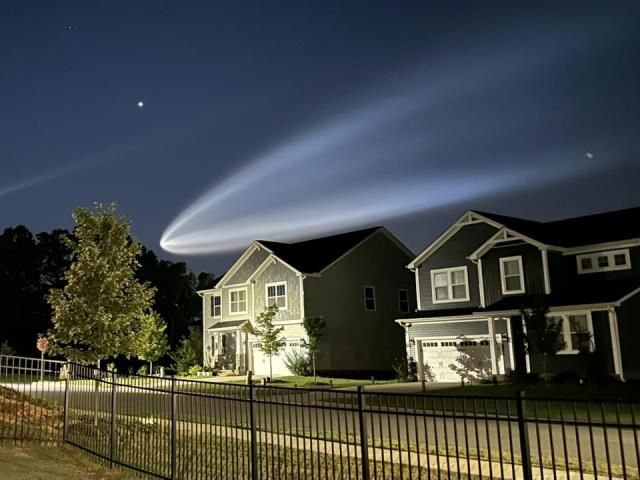
This particular mission marked the 22nd flight for this Falcon 9 first stage booster, demonstrating SpaceX’s remarkable reusability achievements. The rocket lifted off at 5:01 a.m. EDT from Space Launch Complex 40, following a slight delay due to upper-level wind conditions. About eight minutes after launch, the booster successfully landed on the droneship “Just Read the Instructions” stationed in the Atlantic Ocean.

Community Reactions to the Starlink Display
- Local residents flooded social media with photos and videos of the unexpected light show
- Amateur astronomers reported exceptionally clear viewing conditions for this particular pass
- Aviation authorities confirmed receiving multiple UFO reports from pilots before identifying the source
How to Track Future Starlink Satellite Launches
As SpaceX continues its aggressive Starlink deployment schedule—with launches occurring nearly every week—space enthusiasts can prepare to spot these satellite trains using several reliable methods. The satellites are typically most visible during the first 24-72 hours after launch when they remain clustered together before dispersing to their operational orbits.
Several excellent tracking tools are available to the public:
- Heavens-Above.com: Offers real-time tracking maps and detailed pass predictions
- Satellite Tracker mobile apps: Many feature push notifications for visible passes in your area
- SpaceX’s official orbital maps: Released after each satellite deployment
- NASA’s Spot The Station: While primarily for ISS sightings, often captures Starlink trains
Optimal Viewing Conditions
| Condition | Reason |
|---|---|
| Clear skies | Reduces atmospheric interference |
| Dawn/Dusk | Best sunlight reflection angles |
| First 72 hours | Satellites remain close together |
| Rural locations | Less light pollution |
Upcoming SpaceX Starlink Launch Schedule
SpaceX maintains an ambitious launch cadence throughout 2025 as it works to complete its second-generation Starlink constellation. While launch dates frequently change due to weather and technical factors, the current manifest includes several notable missions that may create similar viewing opportunities:
- August 3, 2025: Starlink 7-12 from Vandenberg SFB (23 satellites)
- August 10, 2025: Starlink 6-29 from Cape Canaveral (28 satellites)
- August 17, 2025: Starlink 8-1 from Florida (First Gen2 satellites)
- August 24, 2025: Starlink 7-13 from Vandenberg
- September 2, 2025: Starlink 6-30 from Florida

This relentless launch pace demonstrates SpaceX’s commitment to building a truly global broadband network. The company currently operates over 5,000 Starlink satellites in orbit, with plans to deploy nearly 12,000 in its first-generation constellation and up to 30,000 in its second-generation system.
The Technology Behind Starlink’s Visibility
The remarkable visibility of Starlink satellites shortly after launch results from several deliberate engineering characteristics combined with orbital mechanics:
- Low initial orbit: Deployment at ~350km altitude maximizes visibility
- Flat-panel design: Large reflective surfaces catch sunlight
- Temporary orientation: Satellites fly ‘flat’ before tilting operations
- Clustered formation: Close spacing creates concentrated reflection
Visibility Reduction Efforts
Following criticism from astronomers about light pollution, SpaceX has implemented several measures to reduce Starlink’s visibility:
- VisorSat technology: Sunshades that block reflection
- Dark coating: Special paint that absorbs light
- Operational attitude: Tilting to minimize reflections
- Higher orbits: For second-generation satellites
Photographing Starlink Satellites: A Step-by-Step Guide
Capturing stunning images of Starlink trains requires preparation but can be accomplished with basic photography equipment. Here’s a comprehensive guide:
Essential Equipment
- DSLR or mirrorless camera with manual controls
- Wide-angle lens (14-24mm ideal)
- Sturdy tripod
- Remote shutter release (optional)
- Smartphone with satellite tracking app
Camera Settings
| Setting | Recommendation |
|---|---|
| Aperture | f/2.8 – f/4 |
| Shutter Speed | 15-30 seconds |
| ISO | 800-3200 (depending on conditions) |
| Focus | Manual to infinity |
| White Balance | Daylight or Auto |
Composition Tips
To create frame-worthy Starlink images:
- Include interesting foreground elements (trees, buildings)
- Frame against colorful twilight sky when possible
- Use leading lines to emphasize the satellite train
- Try vertical compositions to capture the entire arc
The Future of Starlink and Satellite Visibility
As SpaceX continues to innovate with its Starlink program, several developments will affect how visible these satellites are from Earth:
- Gen2 satellites: Larger models with different orbital characteristics
- Laser links: Reduced need for ground station visibility
- Higher orbits: Some approved for ~550km altitude
- Improved stealth: Ongoing brightness reduction efforts
The Federal Communications Commission continues to work with SpaceX and other operators to balance the benefits of satellite internet with the needs of astronomers and the beauty of the night sky. Recent approvals require all operators to minimize their impact on astronomical observations.
Comments